

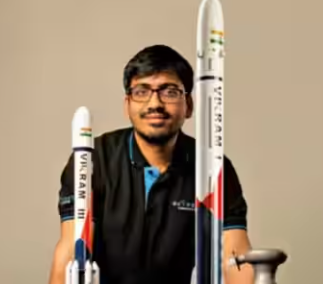
Pawan Kumar Chandana and Naga Bharath Daka had the jobs every Indian engineering student dreams of. Both trained at IIT Kharagpur. Both joined ISRO, working on launch vehicle design at the Vikram Sarabhai Space Centre — inside the organisation that had put India on Mars.
In June 2018 they quit to build rockets in a shed in Hyderabad. On 18 July 2026, their rocket reached orbit.
Why leave the only place in India that built rockets
The reasoning was about the market rather than the engineering. Demand for small satellite launches was growing fast, and supply was severely constrained — operators were waiting months for a slot, or riding as secondary payloads on someone else’s schedule to someone else’s orbit.
National space agencies are not built to solve that. They launch to national priorities. The gap required a commercial company willing to treat launches as a service.
Chandana took the CEO role, Daka became COO, and they named the company Skyroot Aerospace, with rockets named Vikram after Vikram Sarabhai, the father of India’s space programme.
Eight years, two flights
Skyroot flew Vikram-S, a suborbital demonstrator, in November 2022 — India’s first privately built rocket to reach space. That proved the team could build and fly hardware. It did not prove they could reach orbit, which is a fundamentally harder problem involving sustained thrust, staging, guidance and control.
Vikram-1 is India’s first carbon-composite launch vehicle, designed to carry small satellites of up to around 350 kg to low Earth orbit, with roughly 95% indigenous components. In May 2026 Skyroot became India’s first spacetech unicorn, valued at about $1.1 billion after a $60 million round, having raised around $160 million in total.
Mission Aagaman lifted off from the Satish Dhawan Space Centre at Sriharikota at 12:05 pm IST on 18 July 2026 and placed its upper stage in a 450-kilometre orbit about fifteen minutes later. Every principal mission milestone was completed, validating propulsion, avionics, and guidance and navigation under real flight conditions.
India became the third country — after the United States and China — with a private company capable of orbital launch. Prime Minister Narendra Modi called Chandana to congratulate him. Asked for a reaction on stage, Chandana said he had absolutely no words.
The business behind the milestone
One successful flight is a technical achievement, not a company. What Skyroot is selling is cadence: on-demand launches, frequently, at a price the small-satellite market can bear. Chandana has said about 80% of future customers are expected to come from outside India, and has pointed to India’s launch economics as the advantage — faster, more efficient, more economical.
Further test flights are planned across 2026 and 2027. The real test is whether launches become routine rather than historic.
Three things worth noting
Deep expertise is a licence to leave. They did not come from outside the industry. They came from the centre of it, and took that knowledge somewhere it could move faster.
Supply constraints are durable opportunities. Satellite operators queueing for launch slots is a structural shortage, not a temporary one.
Eight years is fast for hardware and slow for everything else. Anyone building physical products needs investors who understand that difference before the first cheque, not after.
Two ISRO engineers walked away from the only place in India that built orbital rockets, and built one anyway. The ambition they state is not another record. It is to make launching a satellite as ordinary as booking a flight.