
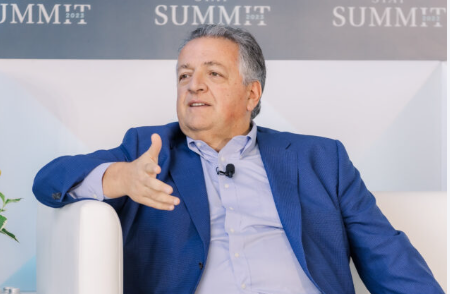
Noubar Afeyan’s grandfather fled Adapazar, in what is now western Turkey, during the Armenian genocide, and ended up in Bulgaria, where Afeyan’s father was born. Afeyan himself was born in Beirut in 1962 and grew up through the start of Lebanon’s civil war. The family left for Montreal.
Three countries in three generations, each departure involuntary. He has spent his career arguing that this is not a sad backstory but a professional advantage.
The immigrant mindset, defined precisely
Afeyan’s phrase for it is the immigrant mindset, and he means something specific by it. An immigrant arrives somewhere with no established position, no network vouching for them, and no option to be average. They must do something unreasonable, persist while people tell them it will not work, and then watch everyone call it obvious years later.
He has said that displacement made him less afraid of operating in survival mode. His sharper claim is that this is learnable, and that anyone who cannot adopt the mindset is at a disadvantage — immigrant or not.
He studied engineering at McGill, completed a PhD in biochemical engineering at MIT in 1987, and built and later sold PerSeptive Biosystems. That gave him the one thing most scientists never acquire: proof that he could turn laboratory work into a company.
A company that builds companies
Rather than become a conventional venture capitalist choosing between other people’s startups, Afeyan founded Flagship Pioneering in 2000 to create companies itself.
The method is deliberately strange. Flagship begins with a “what if” — a scientific proposition that may be impossible — and spends money proving it false as fast as possible. The questions that survive become companies, each numbered at birth.
Flagship has founded more than 100 companies, around thirty of which have gone public. Some no longer exist, which is the design rather than a flaw: the firm does not depend on any single outcome.
Moderna
Moderna was incubated inside Flagship and formally launched in 2010, built on the proposition that messenger RNA could instruct human cells to make their own therapeutic proteins. Afeyan recruited Stéphane Bancel as chief executive in 2011.
For most of the decade that followed, Moderna raised extraordinary sums while publishing comparatively little, and attracted criticism for exactly that. Then a pandemic arrived, the platform was turned toward a new virus, and a prototype vaccine moved into testing with the NIH at a pace the industry had never seen.
Afeyan has resisted calling that a pivot. The platform had been built for precisely this; COVID was the first time the world needed it urgently enough to notice.
He remains chairman of Moderna and CEO of Flagship. He received the US National Medal of Technology and Innovation in 2025, and co-founded humanitarian initiatives including the Aurora Prize and The Future Armenian. In 2026 he has been arguing publicly that a country which stops attracting foreign talent loses its capacity to regenerate.
What is actually portable here
Try to kill the idea early and cheaply. Flagship’s discipline is not conviction but rapid disproof. Most founders spend years gathering evidence for what they already believe.
Build the machine, not the outcome. One successful company is luck. A repeatable method for producing them is an institution.
Your outsider status is an asset you can use deliberately. Having no inherited position means nothing to protect and no convention you are obliged to respect.
Three generations of a family left places they did not want to leave. The grandson built a company whose entire purpose is to pursue ideas everyone else considers unreasonable — until, years later, they look obvious.