
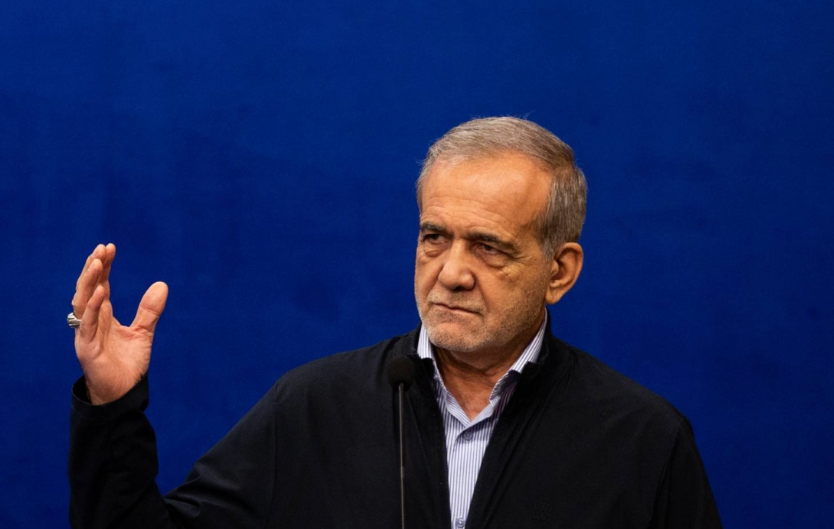
Masoud Pezeshkian was 39 years old when a car crash on an Iranian road took his wife and one of his children. He was a cardiac surgeon then, a man who spent his working days repairing other people’s hearts. He never remarried. He raised his three surviving children alone while running a medical university, and three decades later he became the president of Iran.
From Mahabad to the operating theatre
He was born on 29 September 1954 in Mahabad, a town in Iran’s north-west, to an Azeri father and a Kurdish mother. It was not a background that pointed toward national office. Iran’s political centre of gravity sits in Tehran; Pezeshkian grew up on the country’s ethnic margins, speaking Azeri, in a province more often discussed as a problem to be managed than as a place that produces presidents.
He did his military service before he did his degree. He entered Tabriz University of Medical Sciences in 1976, trained as a heart surgeon, and stayed in academic medicine. When the Iran-Iraq war consumed the 1980s, he organised and dispatched medical teams to the front lines and treated the wounded himself. Eight years of that work shaped a career built on triage: assess, decide, operate, move to the next patient.
The year that changed everything
In 1994 his wife, Fatemeh Majidi, herself a doctor, was killed in a car accident along with one of their children. The same year, he was appointed head of Tabriz University of Medical Sciences, a post he held for roughly five years.
Those two facts sitting in the same year tell you most of what you need to know about how he works. He did not step back. He took on more. He became a single father of three, a practising surgeon, a professor and an administrator at the same time, and he declined to remarry. In a political culture where personal image is carefully constructed, this part of his biography was never constructed. It simply happened, and Iranians watched him carry it.
A second career, started late
Politics came to him in his forties. He joined reformist president Mohammad Khatami’s administration as deputy health minister in 1997, then served as health minister from 2001 to 2005. His record there was administrative rather than ideological: he extended health insurance to around 25 million people in rural Iran and roughly doubled his ministry’s budget by working with parliament rather than fighting it.
When the hardliners took the presidency in 2005, he did not serve. He went back to Tabriz, and in 2008 the city elected him to parliament. He stayed there for sixteen years, a provincial MP with a surgeon’s manner and no national machine behind him, running for president twice without success.
The election nobody planned
In May 2024, President Ebrahim Raisi died in a helicopter crash and Iran was forced into a snap election. Pezeshkian entered it as the only reform-aligned candidate cleared to run, and few expected much. He led the first round, then beat the hardline candidate Saeed Jalili in the runoff with roughly 54 per cent of the vote. He took office on 28 July 2024 at the age of 69, the oldest person ever to hold the job.
He had campaigned on easing enforcement of the mandatory hijab law and re-engaging with the West. Two years earlier, after the death in custody of Mahsa Amini, he had written publicly that it was unacceptable to arrest a young woman over her headscarf and then hand her body to her family. That was the line he walked: pressing for change without challenging the structure of the state itself, a position that has always drawn fire from both directions.
A presidency overtaken by events
Almost none of what he campaigned on has defined his term. War with Israel and the United States, the death of Supreme Leader Ali Khamenei and the succession of Mojtaba Khamenei in March 2026, and the most severe sanctions regime Washington has ever imposed on Iran have consumed it instead. Pezeshkian briefly sat on the three-member interim council that held the Supreme Leader’s duties for a week in March 2026. In September 2026 he led Iran’s delegation to the UN General Assembly in New York.
His domestic position is difficult. Fuel quotas are being cut and prices raised. Hardliners attack him over gestures as small as his shirt sleeves. Rumours of his resignation have circulated more than once and been denied. Whatever one makes of his politics, and Iranians themselves are sharply divided on them, he is governing under conditions no campaign platform anticipated.
What the story holds
Strip away the geopolitics and what remains is a particular kind of life. A boy from a border town with two minority languages at home. A surgeon who treated soldiers in a war. A widower who raised three children alone and took on a bigger job the same year he buried his wife. A politician who lost twice and ran again at 69.
Careers rarely move in a straight line from the margins to the centre. Sometimes they move because a person keeps showing up, long after the moment when stopping would have been forgiven.