

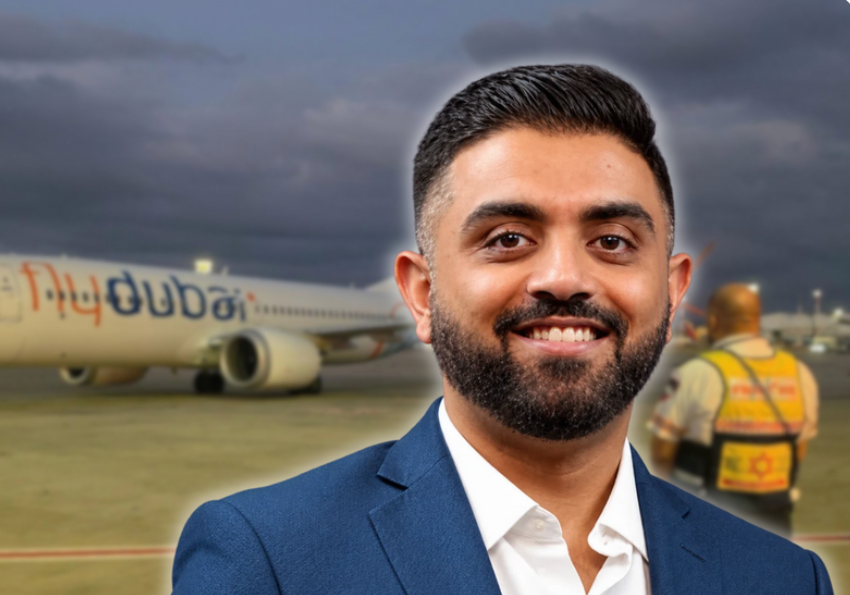
At around 19, Smit Machchhar was studying textile engineering in Mumbai and expecting to join the family business. He went to a seminar about aviation, and changed direction entirely.
On 30 September 2026, lying on the floor of a cockpit at 30,000 feet with stab wounds, that decision was the reason 174 people did not die.
Twelve minutes
Flydubai flight FZ1073 left Dubai for Tel Aviv with 174 people on board. Somewhere over Jordan, according to UAE authorities, the co-pilot attacked Captain Machchhar inside the locked flight deck using the aircraft’s emergency crash axe and tried to take the controls. The UAE has since described it as an attempted terrorist operation. Investigations by Saudi and Emirati authorities are continuing.
Flight-tracking data showed the aircraft dropping more than 17,000 feet in roughly two minutes, then climbing and falling again.
Cockpit doors are locked in flight by design, a safeguard introduced after earlier attacks. Only the pilots can open them. That safeguard meant nobody in the cabin could intervene, however loud it got, and the man bleeding on the floor was the only person who could change that.
He described it afterwards in plain terms: he was on the ground, he could feel the aircraft plummeting, and he understood it was his last chance to do something. He reached the door release and opened it.
Passengers and crew forced their way in and overpowered the attacker. Two off-duty pilots travelling on the flight took the controls and landed the aircraft at Tabuk in north-western Saudi Arabia, where medical and security teams were waiting.
The 13 years that made the 12 minutes possible
Machchhar is from a Mumbai suburb, born into a family in the textile trade. Flying was not a childhood ambition; he has said so himself. After the seminar that redirected him, he trained at a flight school in Dunedin, New Zealand, spending around 18 months there.
He then spent more than eleven years at SpiceJet in India, rising to senior commander and then line training captain, the role responsible for teaching other pilots and conducting their checks. He logged over 6,400 hours as pilot-in-command there. In June 2022 he joined flydubai as a direct-entry captain, and by this year had accumulated roughly 9,750 hours on Boeing 737 aircraft across about 13 years of commercial flying.
None of that is glamorous. Line training, recurrent checks and thousands of uneventful sectors are the unseen bulk of a professional pilot’s life. They are also precisely what produces the capacity to act correctly while grievously injured, with seconds available and no procedure written for the situation.
After
He was taken to hospital in Tabuk, where the Indian embassy in Riyadh reported him in stable condition, and later moved to Abu Dhabi. Speaking to Indian Prime Minister Narendra Modi by video from his hospital bed, he said he had been fighting for his own life, but knew at the same time that he could not let everybody else die. He has also spoken with Israeli Prime Minister Benjamin Netanyahu, who called him a true hero and credited him with preventing a catastrophic mid-air disaster.
He lives in Dubai with his wife and two children. Colleagues have described him as jovial and unremarkable in the best sense: the sort of captain other pilots are glad to be rostered with.
What stays with you
The story is being told as heroism, and it was. But the more useful reading is about preparation.
He did not have a plan for an armed colleague. Nobody does. What he had was a decade and a half of training that made one action available to him when almost nothing else was: open the door, and let the people behind it help. It was the smallest possible move, and it was the only one that worked.
The teenager who walked into an aviation seminar out of curiosity had no idea what he was training for. That is usually how it goes. You put in the years, and much later, in a few seconds you never anticipated, you find out what they were for.