
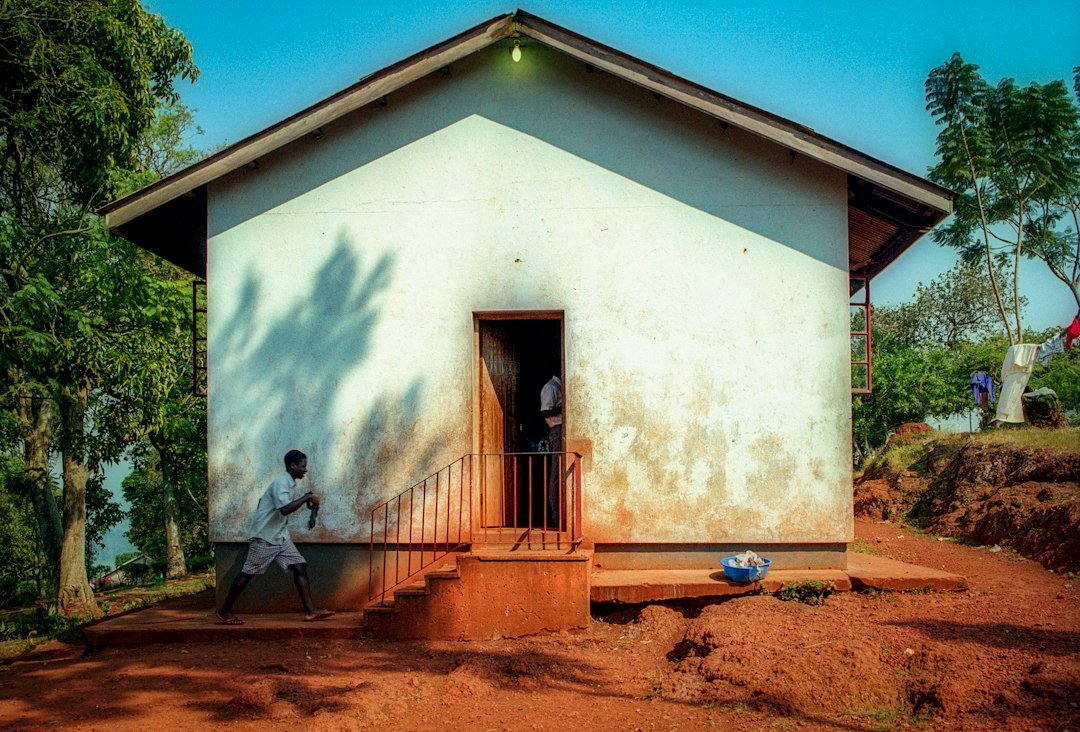
Diébédo Francis Kéré was seven years old when his father sent him away from Gando. It was 1972, and the village had no school. He was the first child in it to be sent for an education, and leaving was the price of getting one.
In 2001, still a student, he went back and built the school himself.
Carpentry in Berlin
Kéré grew up in one of the poorest countries on earth, in a village with no electricity and no clean water. He won a scholarship to study carpentry in Germany — a vocational programme, not an architecture course — and used it as a door. He went on to earn an architecture degree from the Technical University of Berlin.
While still studying, he raised the money for a primary school in Gando himself. That building, completed in 2001, is the origin of everything that followed.
What makes the Gando school unusual
The obvious move for a Berlin-trained architect returning to West Africa would have been concrete — modern, imported, prestigious. Kéré used clay, the material the village already had and already knew how to work.
The problem with clay is that everyone assumed it was poor-man’s material, unfit for a real building. His answer was engineering rather than argument: compressed clay walls that stay cool in extreme heat, and a raised corrugated roof separated from the ceiling so hot air escapes and the classrooms ventilate without electricity.
The village built it. Not as cheap labour, but as the method — local hands, local materials, techniques people could repeat without him.
The Pritzker
In 2022 Kéré won the Pritzker Architecture Prize, the discipline’s highest honour, becoming the first African and the first Black architect to receive it in its history.
By then the portfolio had grown considerably: the Lycée Schorge in Koudougou, the Léo Surgical Clinic and Health Centre, a university built with clay walls and eucalyptus screens, the 2017 Serpentine Pavilion in London, a pavilion at Tippet Rise in Montana made from dead trees, and a master plan for a new Burkina Faso National Assembly to replace the parliament destroyed in the 2014 uprising.
The Thomas Sankara Mausoleum in Ouagadougou opened in 2025. The Goethe-Institut in Dakar completed in 2026. His studio has since designed a healthcare centre in Burundi, again using regional materials and community-based construction, on the reasoning that a pregnant woman carried over rough roads in an ambulance is the clearest argument there is for building care close to where people live.
Sustainability before it had a name
Kéré has said that for much of his career the concept of sustainability was foreign to him. He was not designing to a standard. He was designing for a place with no air conditioning, little money and brutal heat, which produces the same answers by necessity.
That is why his work now scales internationally. He spent two decades solving for the conditions the rest of the world is only now encountering.
What the story holds
Constraints are a design brief, not a disadvantage. No electricity and no budget forced the passive-cooling solutions that became his signature.
Build with what the place already knows. Imported materials need imported expertise, and both leave when the project ends.
Go back. The scholarship could have been a one-way exit. He treated it as a loan from the village and repaid it in buildings.
A boy was sent away because there was no school. He came home with a degree and built one. Everything since is a variation on that single act.