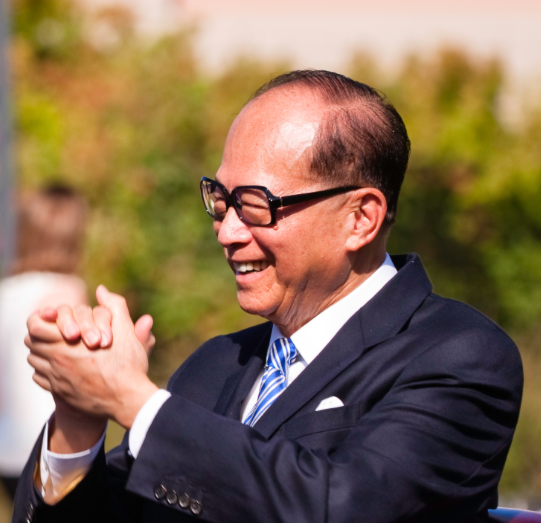
Li Ka-shing was 12 when his family fled Chaozhou for Hong Kong ahead of the Japanese advance. He was 15 when his father died of tuberculosis, leaving him the eldest male in a household with no money. He left school and took a job in a plastics factory, working shifts that ran past 15 hours.
He is 98 now. The company he built is at the centre of a stand-off between Washington and Beijing over who controls the world’s shipping lanes.
Plastic flowers
In 1950, at 22, he used his savings and money borrowed from relatives to start Cheung Kong Industries, making plastic goods. The breakthrough was plastic flowers, an unglamorous product he identified as an export opportunity while reading foreign trade journals, teaching himself English as he went.
The manufacturing was never the point. The cash it generated went into Hong Kong property, and he bought consistently through the periods when everyone else was selling — the 1967 riots, the oil shocks, the handover anxiety of the 1980s. Buying when others cannot is a strategy that requires both nerve and a balance sheet, and he spent decades ensuring he had the second so he could exercise the first.
Taking Hutchison
In 1979 he acquired control of Hutchison Whampoa, one of the old British trading houses that had run Hong Kong’s commerce since the colonial era. He was the first ethnic Chinese businessman to take over one of the hongs, and the deal reset who was understood to hold power in the territory.
What followed was five decades of relentless diversification: container ports, telecoms, retail chains, electricity, infrastructure across Europe. At its peak the group touched an enormous share of daily life in Hong Kong, which earned him both his nickname, Superman, and a degree of public resentment about the cost of living. He also became one of Asia’s largest philanthropists through the Li Ka Shing Foundation, which he has repeatedly described as his third son.
He retired as chairman in May 2018, at 89, handing control to his elder son Victor.
The ports problem
In March 2025, CK Hutchison agreed to sell 43 overseas ports, including the Balboa and Cristobal terminals at either end of the Panama Canal, to a consortium led by BlackRock and Terminal Investment Limited, for roughly US$22.8 billion. Commercially it looked like a clean exit from politically exposed assets at a good price.
It has been anything but clean. Beijing objected within days. The sale slipped past multiple deadlines, and CK Hutchison later moved to bring a mainland partner into the consortium, reported to be Cosco Shipping. In January 2026, Panama’s top court ruled the company’s port concessions there unconstitutional. The group’s interim profit fell sharply on one-off costs. As of this year the transaction remains unresolved.
A deal designed to remove political risk instead demonstrated it. That is the modern condition for any Hong Kong company with global infrastructure: domiciled under Chinese oversight, operating assets that Washington considers strategic.
What the record actually teaches
Cash is optionality. Li’s reputation rests less on brilliant purchases than on having money available when prices collapsed. That required years of unexciting discipline beforehand.
Manufacturing funded the real business. Plastic flowers were never the empire. They were the cash engine that bought the land.
Scale eventually attracts politics. A boy who fled a war built a company large enough that two superpowers now argue over its assets. Size solves many problems and creates a category of problem that money cannot.
The factory worker who taught himself English from trade journals could not have anticipated any of it. But the instinct that got him there — read everything, hold cash, move when others are frozen — is the part that transfers.