
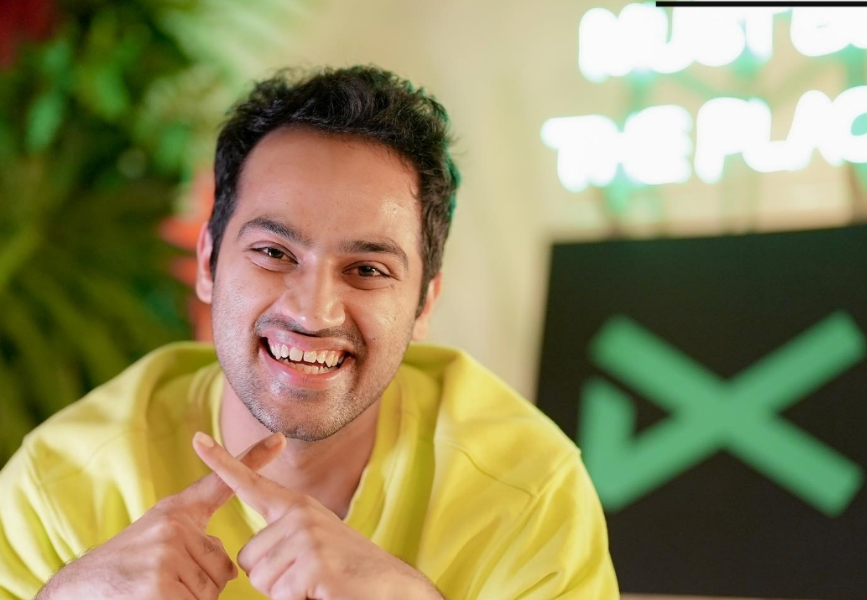
Raj Shamani was 16 when his father had a severe diabetic attack and the family’s income became uncertain. He borrowed ₹10,000, mixed chemicals in buckets on the terrace of his home in Indore, and started selling dishwashing liquid under his own label. It was not a business-school project. It was the kind of ground-level FMCG work where you learn margins, retailer relationships and cash flow because you have no alternative.
Roughly a decade later, he was sitting across a table from the President of France.
The unglamorous first decade
What makes Shamani’s story instructive is that the podcast came last, not first. He joined AIESEC at 16. He represented India at the United Nations Youth Assembly. The terrace operation eventually merged into his family’s chemical trading business to become Shamani Industries, a manufacturer and distributor of household cleaning products.
Then came the speaking circuit: reportedly more than 200 talks across 26 countries, including four TEDx appearances. Then social-first content on Instagram and LinkedIn, built before video was his primary format. Every one of those stages compounded into the next. By the time he launched a podcast, he already had an audience, a network and, crucially, the credibility of someone who had actually run a business with inventory and invoices.
Figuring Out
The show launched in 2021 with a simple premise: learn directly from people further ahead than you, in public. His 2022 book Build, Don’t Talk became a bestseller and reinforced the same positioning.
The numbers have since become difficult to argue with. As of early 2026 the show had passed 540 episodes, with roughly 14.8 million YouTube subscribers and around 400 million views a year. It finished 2025 as Spotify’s top podcast in India, ahead of Joe Rogan and The Diary of a CEO within the Indian market. His guest list includes Bill Gates, Emmanuel Macron, Aamir Khan, MS Dhoni and Gary Vaynerchuk. His four-hour interview with the fugitive businessman Vijay Mallya, Mallya’s first public interview in nine years, drew 20 million views in four days.
In February 2026, after the Macron episode, he stated the target plainly: currently ranked around 25th in the world, and aiming to be first within 18 months. His argument was that there is no Indian, Asian or French podcaster in the global top 10, and that the list is entirely American.
The operator’s question
Shamani is not a journalist, not a comedian and not a broadcaster by training. He is a businessman who built a media property alongside an operating company, and the interviews reflect it. The questions tend to be the ones an owner asks: what did that cost, who paid for it, what broke, what would you do differently.
That is why the show found its particular audience — founders, students, professionals in their twenties and thirties who want to understand how money and institutions actually work in India, rather than hear another motivational monologue.
The cost of the platform
Scale of this kind brings scrutiny, and Shamani has had his share. The Mallya interview drew criticism that the format let a controversial figure present his own narrative largely unchallenged. In 2025 the actor Anupam Kher publicly alleged that his interview had been edited in a way that removed key remarks. Later that year Shamani took down an episode featuring a self-described forex trader after viewers raised allegations about the guest.
These episodes point at the central tension of creator-led media. A long-form interview show has the reach of a television network and none of its editorial apparatus. When a single host controls booking, questioning and the final edit, every one of those decisions is visible and attributable to one person.
What founders can take from it
Distribution is now a business asset, not a marketing line item. Shamani built an audience before he needed one. When he wanted global guests, the audience was the pitch.
Operating experience is a moat in media. Anyone can start a podcast. Very few hosts have run a manufacturing business, and it shows in the questions they ask.
Boring compounding beats a viral moment. Buckets on a terrace, AIESEC, 200 speaking gigs, LinkedIn posts, then a podcast. None of it looked like the destination while it was happening.
The teenager selling dishwashing liquid in Indore did not have a media strategy. He had a family emergency and ₹10,000 of borrowed money. Everything afterwards was built on the habits that year taught him.