
Every aircraft ever built has had to land. It carries its flight in a tank or a battery pack, burns through it, and comes down. That single constraint is why the ocean — most of the planet’s surface — remains largely unwatched in real time.
Samay Sanghvi’s company is built on removing that assumption. Not extending the endurance. Removing the landing.
No degree, 200 crashes
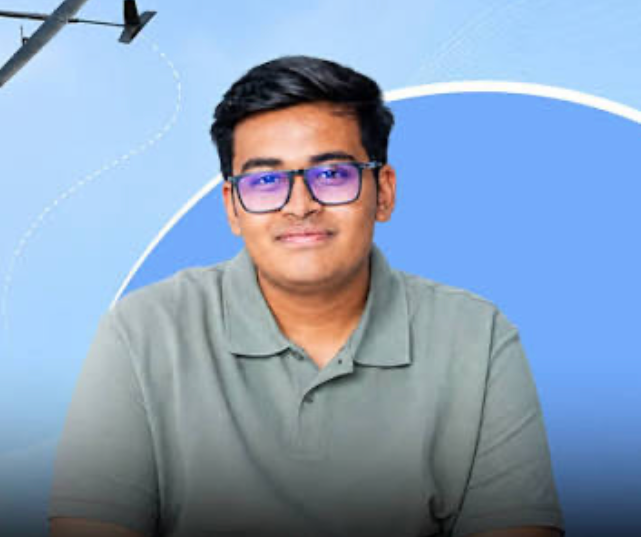
Sanghvi began working on the technology in 2023, straight out of high school, and incorporated Alteon in Bengaluru in 2025. He has no formal engineering degree. He taught himself by building radio-controlled aircraft, flying them, crashing them, and building the next one.
That sounds like a charming origin detail until you look at how the company still operates: four to five aircraft built a week, and more than 200 test flights in a single recent month. The self-taught method did not stop when the funding arrived. It became the process.
What an albatross knows
The physics Alteon is chasing is called dynamic soaring, and albatrosses have used it for millions of years to cross oceans while barely flapping.
Above the sea, air moves at different speeds in layers — slower near the surface where friction drags on it, faster above. An albatross dives into the slow layer, banks, and climbs back through the fast one, gaining a little energy on each crossing. Repeat the loop and the bird travels thousands of kilometres on wind rather than on muscle.
Alteon’s aircraft, initially around a three-metre wingspan, is designed to do the same thing autonomously: skim close to the water, climb, turn through faster air, and bank more energy than the manoeuvre costs. Do it indefinitely and the aircraft never needs to land.
As Sanghvi puts it, ultra-high endurance is downstream of ultra-high efficiency, precision and reliability.
The milestone, and the one that matters more
In August 2026, Alteon flew autonomously within one metre of the ocean’s surface. That is the hard half of the manoeuvre — holding a precise altitude above a surface that is moving, breaking and throwing spray, with turbulence and shifting light to contend with.
In September the company raised $2.5 million in pre-seed funding from Lachy Groom and Together Fund, and has grown to a team of about 20.
What it has not yet done is the thing the entire business rests on. Flying the manoeuvre is not the same as profiting from it. The next milestone, which Sanghvi names himself, is energy-neutral dynamic soaring: propulsion switched off, the aircraft holding flight on harvested wind alone.
Aerodynamicists who have looked at the approach raise a consistent objection. Large-scale wind patterns above the ocean are reasonably predictable, but local shear and turbulence are not, and an aircraft must continuously find and exploit conditions that keep changing.
Why anyone would fund it
The ocean is the biggest unmonitored surface on the planet. Watching it today means ships, which are expensive and slow, or satellites, which are expensive and periodic. Neither gives persistent real-time coverage of a given patch of water.
An aircraft that stays up for months changes the economics of maritime surveillance, search and rescue, environmental monitoring and defence, because the asset stops being a sortie and becomes infrastructure.
What the story is really about
A falsifiable milestone beats a good pitch. Sanghvi has publicly named the test that proves or kills the thesis. Most founders avoid that.
Iteration speed is the moat. Four aircraft a week means learning faster than better-funded competitors who build one and protect it.
Credentials are a proxy, not the thing. He had no degree. He had hundreds of flights and the willingness to crash.
Nature solved this problem a long time ago. The hard part was never the idea — it is teaching a machine to read the wind the way a bird does, a metre above the water, every few seconds, for a year.