
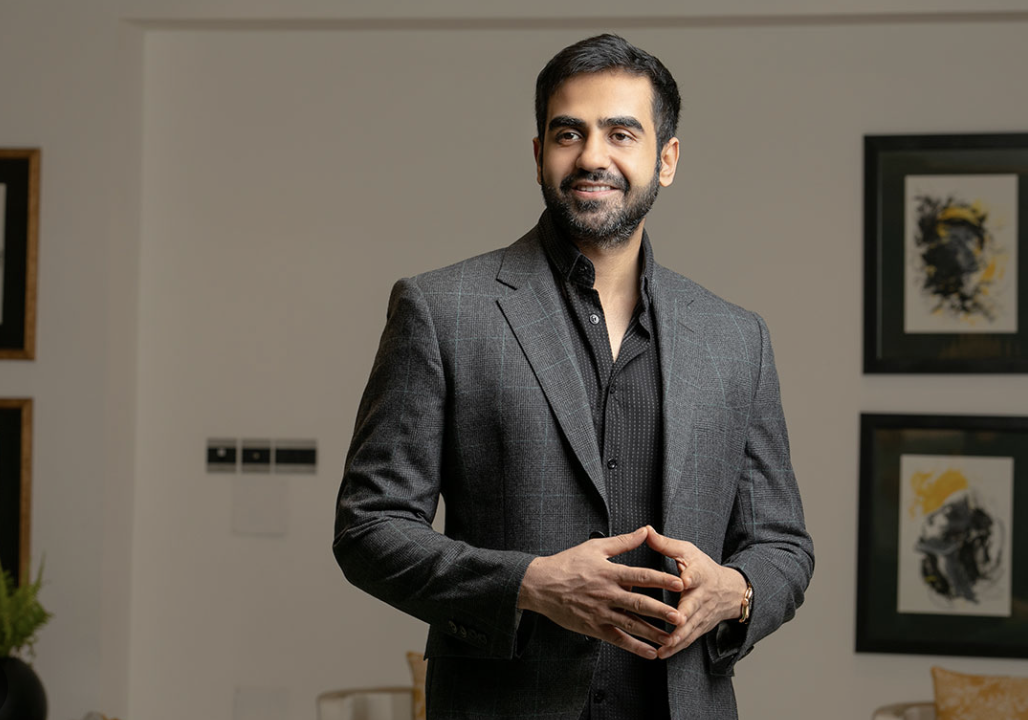
Nikhil Kamath was born September 5, 1986, in Shimoga, Karnataka, to a middle-class Konkani family. His father, U.R. Kamath, was an executive at Canara Bank. His mother, Revathi Kamath, was a veena artist who instilled in her children a love for music and discipline. Nothing about Nikhil’s upbringing suggested he’d become a billionaire by 37.
At age 14, Nikhil dropped out of school after completing 10th grade. Not because he failed—because he was obsessed with chess. He wanted to represent India professionally and spent his days studying chess strategies instead of textbooks. His parents were worried. Indian society places enormous emphasis on education—dropping out of school at 14 seemed like career suicide.
But chess taught Nikhil strategic thinking, pattern recognition, and decision-making under pressure—skills that would later make him a billionaire trader. When his chess career didn’t pan out professionally, Nikhil needed money. At 17, he started working night shifts at a call center earning ₹8,000 per month ($100). He sold mobile phones on the side to supplement income.
While most teenagers his age were preparing for college entrance exams, Nikhil was discovering stock trading. He opened a trading account with ₹10,000 and started studying market patterns obsessively. He treated trading like chess—analyzing moves, studying opponents (the market), and thinking several steps ahead.
The challenge was brutal. Nikhil had no formal finance education, no mentors, and was competing against traders with MBAs and decades of experience. Most people would have quit. Nikhil saw it as the ultimate strategic game.
His call center colleagues noticed he was consistently making money in the markets. They started asking him to manage their money. By his final year at the call center, Nikhil was managing investments for his entire team. The performance was strong enough that he could quit his job and trade full-time.
In 2010, Nikhil’s older brother Nithin Kamath approached him with an idea: start a discount brokerage that democratizes investing for everyday Indians. At the time, India’s stock market was dominated by expensive full-service brokers charging hefty commissions. Retail investors were getting destroyed by high fees.
Nikhil and Nithin co-founded Zerodha with a radical proposition: flat-fee brokerage of ₹20 per trade regardless of trade size, zero brokerage on equity delivery. The name ‘Zerodha’ combined ‘Zero’ and ‘Rodha’ (Sanskrit for barrier)—their mission was removing barriers to investing.
But the challenge was existential: could two brothers with no external funding, operating from Bangalore, compete against established giants backed by banks and institutions? Everyone said no. Nikhil and Nithin built anyway.
The Turning Point
The turning point for Zerodha wasn’t a single moment—it was a series of strategic decisions that compounded over a decade.
Zerodha launched in 2010 with no venture capital, no advertising budget, and no PR. The Kamath brothers built everything themselves—technology platform, customer service, compliance infrastructure. This bootstrap mentality kept the company lean, profitable, and focused on customers instead of investors.While competitors relied on clunky legacy systems, Zerodha built Kite—a lightning-fast, beautiful, web-based trading platform. Kite was so good that even experienced traders abandoned their old brokers. User experience became Zerodha’s moat.Zerodha launched Varsity, a free educational platform teaching Indians how to invest and trade. Instead of keeping knowledge proprietary, they gave it away. This built trust and created informed customers who appreciated Zerodha’s transparency.
Zerodha expanded beyond trading:
• Coin: Commission-free mutual fund platform
• Console: Portfolio analytics and insights
• Smallcase: Thematic investment baskets
• Streak: Algorithmic trading for retail investors
Each product solved real problems retail investors faced. The ecosystem locked in customers—they didn’t just trade on Zerodha, they managed their entire financial lives there.
When COVID lockdowns hit in 2020, millions of Indians stuck at home discovered stock trading. Zerodha was perfectly positioned. The platform was digital-first, onboarding was seamless, and customer service was responsive. User growth exploded.
By 2021, Zerodha became India’s largest retail broker by active clients, surpassing legacy institutions that had been around for decades. By 2024, Zerodha handles 15% of India’s total retail trading volume, averaging over $10 billion daily turnover.
In October 2023, Nikhil Kamath officially became India’s youngest billionaire at age 37. His net worth: $3.3 billion according to Forbes. Zerodha’s valuation: ₹64,800 crore ($8+ billion). And the most remarkable part? They never raised external funding. The Kamath brothers still own 100% of the company.
The Strategy: Patience Over Hype
While startups around them raised millions, Zerodha stayed bootstrapped.
No venture capital.
No aggressive burn.
No valuation drama.
They focused on:
- Flat ₹20 per trade
- Zero brokerage on delivery
- A powerful trading platform (Kite)
- Financial education through Varsity
They chose trust over noise.
Profit over press coverage.
Long-term vision over short-term hype.
And the market rewarded them.
The Result: Quietly Becoming a Giant
Today, Zerodha is India’s largest retail stockbroker, serving millions of investors.
Nikhil Kamath became one of India’s youngest self-made billionaires — not because he raised capital, but because he built value.
But the real success isn’t wealth.
It’s this:
- A bootstrapped company in a VC-driven world
- Sustainable profitability in fintech
- Democratized investing for millions of Indians
- Building Rainmatter to support future entrepreneurs
His story proves something powerful:
You don’t need pedigree.
You don’t need funding headlines.
You don’t need to follow the crowd.
You need conviction, patience, and courage to build differently.
In a world chasing unicorn tags, Nikhil Kamath built something rarer — a disciplined, profitable, and trusted institution.