

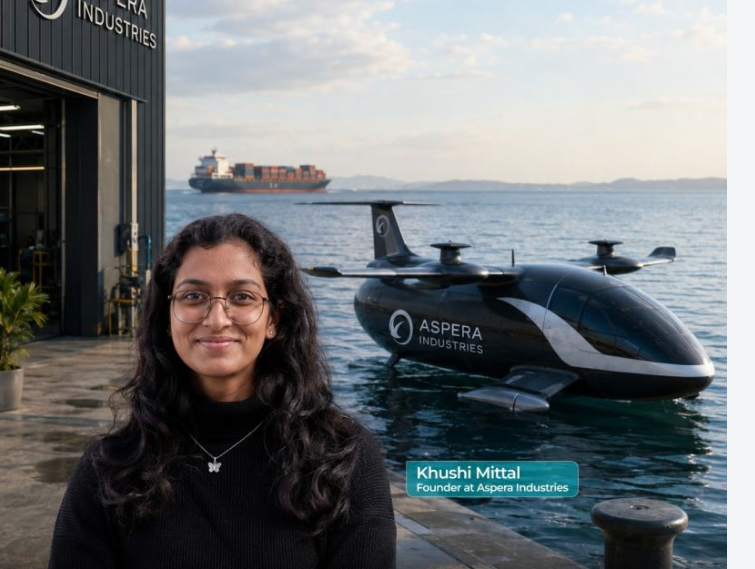
Roughly 80% of world trade moves by sea. It moves that way for one reason: flying the same cargo costs about twenty times more. So manufacturers hold three to six weeks of buffer inventory, capital sits in containers, and everyone treats the delay as a law of physics.
Khushi Mittal’s position is that it is not a law of anything. It is an engineering problem, and engineering problems have solutions.
The dropout
Mittal was born in Kolkata and was studying physics and computer science at the University of Alberta, working in reinforcement learning, when she left to start a company. She founded Aspera Industries in June 2025 and based it in Bengaluru, alongside co-founders Abdul Paravengal and Rishab Chitgopekar.
Dropping out to build software is a familiar story. Dropping out to build aircraft is a different proposition entirely. Aerospace has long development cycles, heavy capital requirements and a regulator that must approve anything that flies. There is no minimum viable product that skips physics.
Eureka
On 29 August 2026, Aspera unveiled its first aircraft, Eureka: an autonomous amphibious cargo plane designed to carry around 1,000 kilograms over a stated range of 2,000 kilometres, taking off and landing on water rather than tarmac.
The reasoning behind the water runway is the most interesting part of the pitch. Mittal has pointed out that 150 of the world’s 193 countries have a coastline, and that ports, cities and factories have always clustered around water anyway. Using water as the runway gives access to roughly 71% of the planet’s surface without building a single new airport.
Seaplanes have existed for a century and largely died out because the stepped hull that lets them lift off water creates constant drag in flight, which ruins the economics. Aspera’s answer is to delete the step and use retractable hydrofoils instead: foils down for take-off and landing, foils up and clean airframe in cruise.
The target is under $1 per tonne-kilometre on the first aircraft, which the company expects to fall below 50 cents at fleet scale. If that holds, flying stops being the premium option for anything urgent, perishable or valuable.
Build it and fly it
Aspera intends to manufacture the aircraft and operate the logistics service itself, rather than selling planes to carriers. That is a harder business to finance and a much harder one to execute, but it keeps the cargo-specific design decisions and the customer relationship in the same hands.
The company has also talked about a larger aircraft able to lift five to ten tonnes from unprepared airstrips of 500 to 800 metres, aimed at middle-mile freight — warehouse to warehouse, port to port — and a longer-term ambition to build an autonomous airliner in India. It has raised roughly $750,000 in seed funding, with Inuka Capital among its backers, and remains at the prototyping stage.
What has to go right
The honest version of this story includes the obstacles. India’s drone rules cap fully autonomous unmanned operations at 500 kg; anything heavier is expected to follow the manned certification path under the Aircraft Rules of 1937, a process measured in years rather than sprints. The cost claims are projections, not operating data. And Aspera is not alone — Airbound recently raised $37 million for its own autonomous cargo aircraft.
None of that makes the thesis wrong. It makes it a long bet, which is what deep tech is.
The idea underneath
India’s logistics costs run at roughly 14% of GDP against 8-10% in developed economies. That gap is not a statistic, it is a tax on every manufacturer, exporter and small business in the country. Most attempts to close it involve better roads, bigger ports and more rail — infrastructure measured in decades and billions.
Mittal’s bet is that you can skip the infrastructure entirely if the runway is already there. The water is free. The question is whether the aircraft can be built cheaply enough to use it.
That is the kind of question worth dropping out for.